
Does Xanax Reduce Blood Pressure? What the Evidence Says
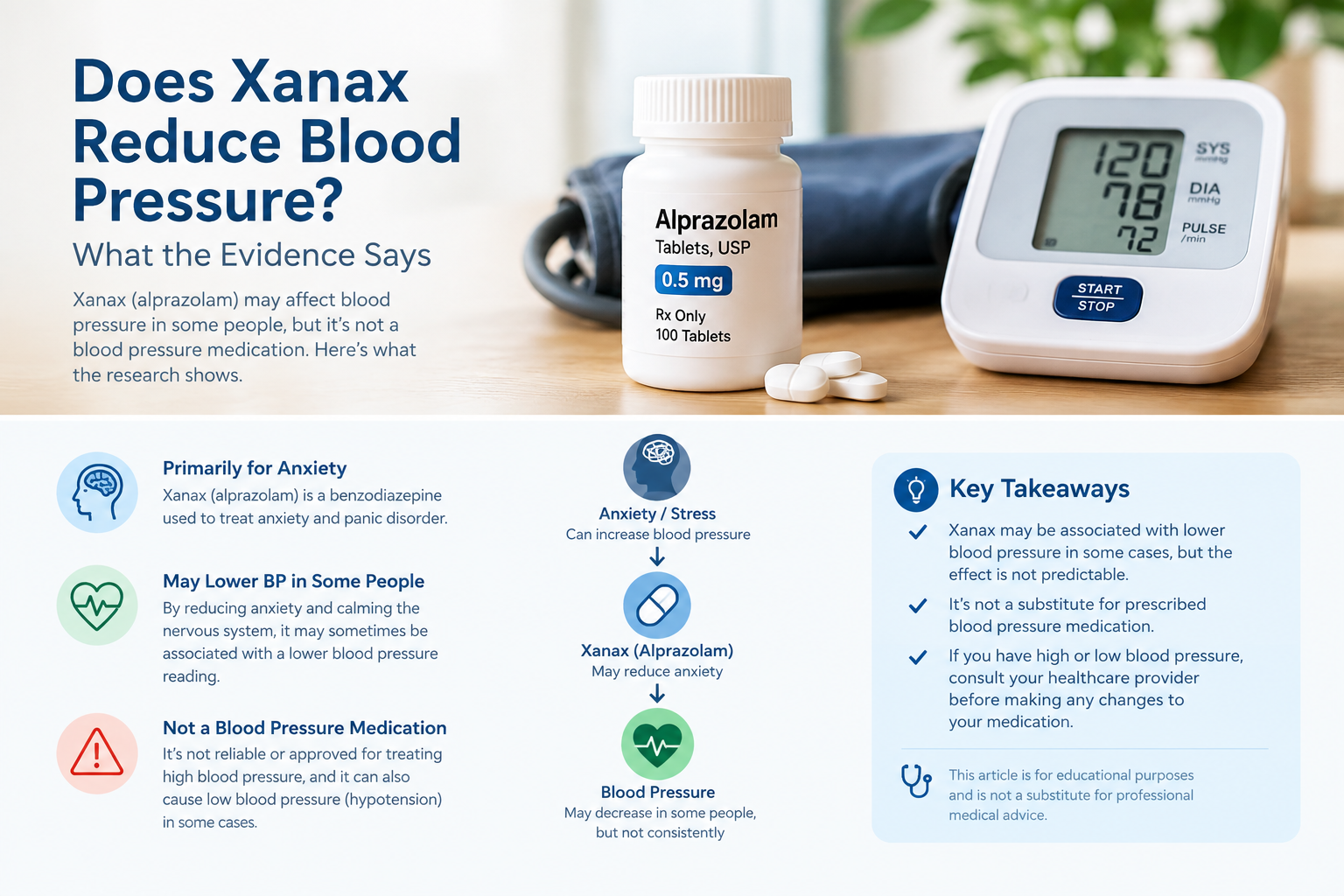
Does Xanax Reduce Blood Pressure?
If you have noticed a change in your blood pressure after taking Xanax, you may wonder: does Xanax reduce blood pressure?
The short answer is: Xanax (alprazolam) can sometimes be associated with lower blood pressure, but it is not a blood-pressure medication and should not be used to treat hypertension.
The relationship is more complicated than simply saying that Xanax lowers blood pressure. Alprazolam is a benzodiazepine prescribed primarily for anxiety and panic disorder. By reducing central nervous system activity and anxiety, it may influence some of the physical effects associated with stress. However, clinical research has not consistently shown alprazolam to produce a reliable blood-pressure-lowering effect.
In one randomized crossover study involving patients with mild hypertension, alprazolam did not significantly change 24-hour or daytime systolic or diastolic blood pressure compared with placebo.
At the same time, research involving benzodiazepines as a broader drug class suggests that they may produce short-term reductions in blood pressure in some people, particularly when anxiety or acute stress contributes to elevated readings. The evidence is still considered inconclusive.
Key Takeaway
Xanax may lower blood pressure in some circumstances, but it is not a dependable treatment for high blood pressure. Any change in blood pressure after taking alprazolam can depend on factors such as anxiety, dosage, other medications, individual response, and underlying health conditions.
If you take Xanax as prescribed, do not change your dose or take an additional dose simply to lower your blood pressure.
What Is Xanax?
Xanax is the brand name for alprazolam, a prescription benzodiazepine.
It is primarily used to treat anxiety disorders and panic disorder. Alprazolam works by enhancing the effects of gamma-aminobutyric acid (GABA), an inhibitory neurotransmitter in the central nervous system. This reduces excessive neuronal activity and produces a calming effect.
Because anxiety and stress can temporarily increase heart rate and blood pressure, reducing anxiety can sometimes be accompanied by a lower blood pressure reading.
That does not mean Xanax functions like a conventional blood-pressure medication.
The official prescribing information for alprazolam lists hypotension, or low blood pressure, among reported adverse reactions.
Does Xanax Reduce Blood Pressure?
It can, but not consistently or predictably.
There are several reasons someone might see a lower blood pressure reading after taking Xanax.
1. Reducing anxiety may reduce a temporary blood pressure increase
Anxiety activates the body’s stress response. During periods of significant anxiety or panic, stress-related physiological changes can temporarily raise blood pressure.
If alprazolam reduces that anxiety, the person’s blood pressure may move closer to their usual level.
In this situation, the medication may be indirectly associated with a lower reading rather than acting as a conventional antihypertensive drug.
Research has demonstrated a relationship between anxiety and acute blood-pressure elevations, and some studies have investigated whether reducing anxiety with alprazolam can affect those readings.
2. Alprazolam can affect the central nervous system
Xanax is a central nervous system depressant. Its effects can include sedation and relaxation.
These effects can influence cardiovascular measurements in some individuals, but the magnitude and clinical importance vary.
3. Some people can experience hypotension
Low blood pressure is a recognized adverse reaction to alprazolam.
A person who experiences a significant drop in blood pressure may notice symptoms such as:
- Dizziness
- Lightheadedness
- Weakness
- Feeling faint
- Blurred vision
- Fatigue
If these symptoms are severe, persistent, or associated with fainting, medical evaluation may be necessary.
What Does the Research Say About Xanax and Blood Pressure?
The research is more nuanced than a simple “yes” or “no.”
A randomized crossover study published in the Journal of Clinical Psychopharmacology evaluated alprazolam in patients with mild hypertension. Participants received alprazolam, lorazepam, or placebo during different treatment periods.
The researchers found that alprazolam did not significantly affect 24-hour or daytime systolic or diastolic blood pressure compared with placebo. Nighttime blood pressure also was not significantly affected by alprazolam.
Another randomized study examined patients arriving at an emergency department with elevated blood pressure and high levels of anxiety. Participants received either alprazolam or captopril. Blood pressure decreased during the two-hour observation period in both groups, but the study involved a small sample, and the relationship between anxiety and blood pressure was an important part of the findings.
A 2023 systematic review and meta-analysis looked more broadly at benzodiazepines and blood pressure. It found evidence that benzodiazepines may reduce blood pressure in the short term in some patients, but the researchers emphasized that the available evidence was not definitive and that additional research was needed.
What does this mean for you?
The most accurate conclusion is:
Xanax may affect blood pressure in some people, but you cannot rely on it to lower high blood pressure.
That distinction is important because an individual blood-pressure reading can change for many reasons, including stress, pain, activity, caffeine, medications, and the technique used to measure blood pressure.
How Fast Does Xanax Lower Blood Pressure?
There is no reliable timeframe in which Xanax is expected to lower blood pressure because alprazolam is not prescribed as a blood-pressure-lowering medication.
Some people may notice the effects of alprazolam relatively soon after taking an oral dose, but that does not mean a specific blood-pressure reduction will occur at a predictable time.
The effect on blood pressure can vary depending on:
- The prescribed dose
- Individual metabolism
- Age
- Other medications
- Alcohol or other central nervous system depressants
- Anxiety level
- Existing blood pressure
- Other medical conditions
- Whether the blood-pressure reading was taken at rest
Therefore, taking Xanax specifically because your blood pressure is elevated is not an appropriate substitute for evaluation or treatment of hypertension.
Can Xanax Lower Blood Pressure if Anxiety Is Causing It to Rise?
Possibly.
This is one of the most important distinctions when discussing Xanax and blood pressure.
Suppose someone becomes extremely anxious before a medical appointment. Their stress response may temporarily increase their heart rate and blood pressure. If their anxiety decreases, their blood pressure may also decrease.
In that situation, the lower reading may partly reflect a reduction in anxiety and stress rather than a direct antihypertensive effect.
Research has found an association between anxiety and acute blood-pressure elevations, and experimental research involving alprazolam has demonstrated effects on physiological responses to psychosocial stress.
This is different from treating chronic hypertension.
Is Xanax a Blood Pressure Medication?
No.
Xanax (alprazolam) is a benzodiazepine used primarily for anxiety and panic disorder. It is not a standard medication for treating hypertension.
Blood-pressure medications belong to different drug classes, including:
- ACE inhibitors
- Angiotensin II receptor blockers (ARBs)
- Calcium channel blockers
- Thiazide-type diuretics
- Beta blockers in selected situations
The appropriate medication depends on the individual’s blood pressure, medical history, kidney function, cardiovascular risk, other medications, and other factors.
If you have consistently high blood-pressure readings, speak with a healthcare professional rather than using Xanax to try to lower them.
Can Xanax Cause Low Blood Pressure?
Yes.
Hypotension is listed among the adverse reactions associated with alprazolam.
However, experiencing low blood pressure after taking Xanax does not mean that the medication should be used to intentionally lower blood pressure.
Low blood pressure can become a problem when it causes inadequate blood flow to the brain and other organs or produces significant symptoms.
Watch for symptoms such as:
- Severe dizziness
- Fainting
- Confusion
- Unusual weakness
- Difficulty staying awake
- Severe or worsening symptoms
If someone loses consciousness, has difficulty breathing, or has another medical emergency, seek emergency medical care.
What Can Make Blood Pressure Drop More After Taking Xanax?
The effects of alprazolam can be influenced by other substances and medications.
Alcohol
Alcohol and alprazolam both depress the central nervous system. Combining them can increase sedation and other risks.
The official prescribing information specifically warns about concomitant use with alcohol and other central nervous system depressants.
Other medications
Other prescription or over-the-counter medications may interact with alprazolam or contribute to dizziness, sedation, or blood-pressure changes.
Tell your healthcare professional about all medications and supplements you take.
Dehydration
Being dehydrated can contribute to low blood pressure and dizziness. If you are taking a medication that can also contribute to these symptoms, the combination may make you feel worse.
Existing low blood pressure
If your blood pressure is already low, any additional reduction may be more noticeable.
Does Xanax Lower Blood Pressure More Than Blood Pressure Medication?
Not in the sense that it should be considered an alternative treatment.
A controlled study comparing alprazolam with the antihypertensive drug captopril in anxious patients with markedly elevated blood pressure found reductions in blood pressure over two hours in both groups. However, that study was small, and it does not establish alprazolam as a replacement for antihypertensive therapy.
Other research has found no significant effect of alprazolam on ambulatory blood pressure in patients with mild hypertension.
The evidence therefore does not support taking Xanax as a general treatment for high blood pressure.
Should You Take Xanax If Your Blood Pressure Is High?
Do not take Xanax specifically to lower a high blood-pressure reading unless your healthcare professional has instructed you to take it for your diagnosed condition.
If you already have a prescription for alprazolam, take it exactly as prescribed.
If your blood pressure is repeatedly elevated, keep a record of your readings and discuss them with your healthcare professional. They can determine whether you need further evaluation or treatment.
Do not increase your Xanax dose because your blood pressure is high.
Alprazolam also carries important risks related to misuse, dependence, and withdrawal. The official U.S. prescribing information includes warnings concerning abuse, misuse, addiction, and dependence.
What Should You Do If Your Blood Pressure Is High?
First, avoid assuming that one elevated reading means you have chronic hypertension.
For a more reliable reading:
- Sit quietly for several minutes.
- Keep your back supported.
- Keep both feet flat on the floor.
- Support your arm at heart level.
- Avoid talking during the measurement.
- Take another reading according to your healthcare professional’s advice.
- Record the readings so you can discuss the pattern with a healthcare professional.
If your readings remain unusually high, contact a healthcare professional for appropriate guidance.
When is high blood pressure an emergency?
Very high blood pressure accompanied by concerning symptoms requires urgent medical attention.
Seek emergency care for symptoms such as:
- Chest pain
- Severe shortness of breath
- New weakness or numbness
- Difficulty speaking
- Sudden vision changes
- Severe confusion
- Loss of consciousness
- Other sudden, severe symptoms
Do not attempt to treat a potentially serious blood-pressure problem by taking extra Xanax.
Frequently Asked Questions
Does Xanax lower blood pressure immediately?
Not reliably. Xanax is not a blood-pressure medication, and there is no predictable amount by which it will lower blood pressure or a guaranteed timeframe for a reduction. Some people may experience changes in blood pressure, particularly when anxiety decreases, while controlled research has also found no significant effect on ambulatory blood pressure.
Does Xanax lower blood pressure or heart rate?
Xanax can affect the central nervous system and may be associated with cardiovascular changes in some people. However, research in patients with mild hypertension found no significant effect of alprazolam on 24-hour or daytime blood pressure or heart rate.
Can Xanax cause low blood pressure?
Yes. Hypotension is listed among the reported adverse reactions of alprazolam.
How long does Xanax affect blood pressure?
There is no standard duration for a blood-pressure effect because alprazolam is not intended to control blood pressure. Any change can vary substantially between individuals and may be influenced by anxiety, dose, other medications, and underlying health conditions
Can I take Xanax for high blood pressure?
Xanax should not be used as a substitute for prescribed blood-pressure treatment. If you have high blood pressure, discuss your readings and treatment options with a healthcare professional.
Does Xanax lower blood pressure caused by anxiety?
Reducing anxiety can sometimes reduce a temporary stress-related increase in blood pressure. However, that does not mean alprazolam is a treatment for hypertension. Research on benzodiazepines and blood pressure remains mixed.
There are no comments